
 LANGUAGE
 English
 Deutsch
 Español
 Français
 русский

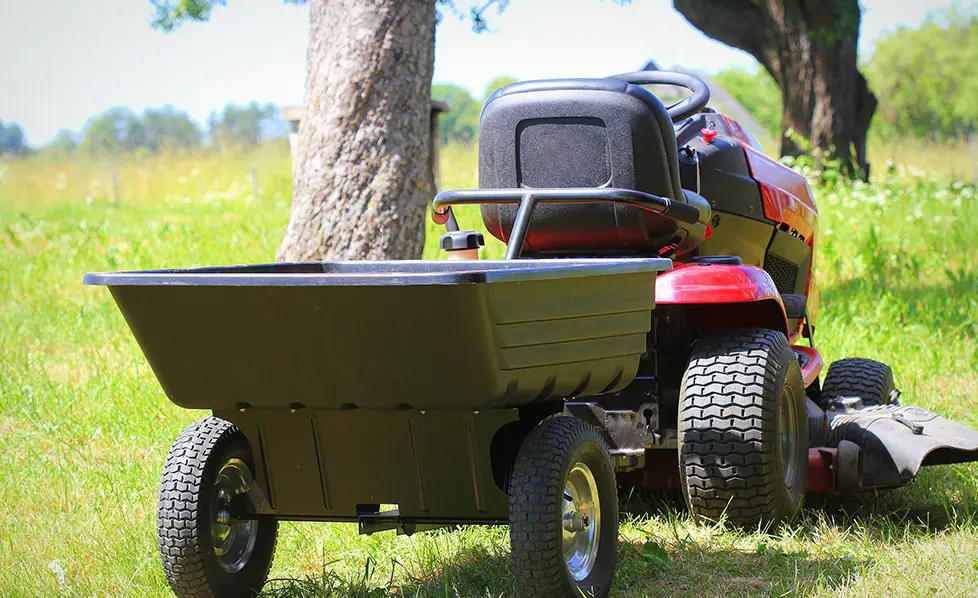











◆MODEL NO.: SP22111 ◆CAPACITY:500LB/10CU.FT ◆THE POLY BED IS QUIET AND...
See Details
Poly Dump Cart Buying Guide: Capacity, Axles, Dump Action, Tires, and More
You have eight cubic yards of mulch to move, a 32 inch garden gate, and a lawn that stays soft for two days after rain. The dump cart you order this week decides whether that job takes two afternoons or two weekends.
The short answer: for most households a poly (HDPE) dump cart rated 600 lb to 1,000 lb, with a swivel or four-wheel axle, pneumatic tires and a metal dump latch will move mulch, soil, gravel, firewood and garden waste for years without rusting. Buy above your heaviest realistic load, inspect the axle before the tub, and expect to pay more for bearings and tires than for the plastic bed itself.
This guide follows the order that matters when you compare models: real load, bed material, axle and tires, dump mechanism, then the ratings printed on the spec sheet.
The Short Answer: Buy for Load Capacity, Not Tub Size
Tub size is the easiest number to compare and the least useful on its own. Five specifications decide whether the cart still works after a full season:
- Payload rating, measured against your heaviest realistic load with margin left over.
- Axle and wheel size, which determine how weight travels over ruts, curbs and slopes.
- Dump mechanism and latch, which either release smoothly under full load or jam halfway.
- Tire type, which decides whether you leave ruts in a wet lawn or stop dead on gravel.
- Bed material, which has to match what you move most often.
A cart rated at its limit on level pavement is over its limit on a slope with a wet load. Leave at least 20 percent headroom, and check the axle before you fall in love with the tub.
Work Out Your Real Load Before You Compare Carts
Volume is a poor measure of work, because materials differ so much in density. These are practical working figures:
- Dry mulch or shredded leaves: 30 to 40 lb per cubic foot.
- Compost: 40 to 50 lb per cubic foot.
- Wet topsoil: 80 to 100 lb per cubic foot.
- Gravel or crushed stone: 100 to 110 lb per cubic foot.
A 600 lb cart therefore carries roughly 6 cubic feet of wet soil, about a quarter of a cubic yard, but close to 15 cubic feet of mulch. That single difference explains why two owners of the same cart report opposite experiences: one is moving leaves, the other is moving stone.
Add a 20 percent margin for slopes, saturated loads and uneven ground. Ratings are validated on level ground with evenly spread loads; material pushed into one corner can bend a light axle well before the rated figure is reached.
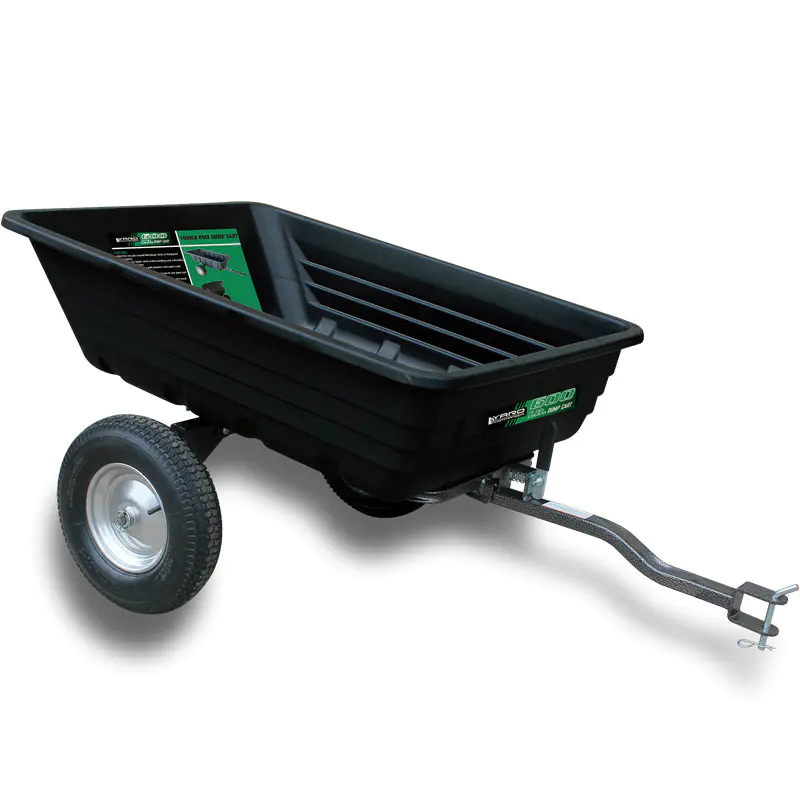 600 lb Poly Dump Cart SP 22144A 600 lb poly dump cart with quick-release tipper latch, steel frame, and sealed bearings for home, farm, and landscaping tasks.View Product →
Poly, Steel or Mesh: Match the Bed to What You Haul
Poly beds are molded from high-density polyethylene. They do not rust, they do not dent, and wet soil slides out instead of sticking to the sides. They also shrug off fertilizer, manure and road salt, which is why they are the default choice for garden work. Material grade is what matters: UV-stabilized virgin HDPE keeps its impact strength in cold weather, while thin recycled blends can crack at the mounting bolts after a hard freeze.
Steel beds handle sharp, abrasive loads better. If you move crushed rock, broken concrete or scrap metal, a steel cart will outlast a poly one. Check how the coating is applied, because rust starts at cut edges, weld seams and bolt holes. Mesh carts suit light, bulky material such as leaves and pruned branches, but they are a poor choice for sand, cement or screened topsoil.
If you want to see how a poly bed is actually built, the structural features of a poly dump cart are worth reading before you compare prices.
Axles, Bearings and Tires Carry the Load
Two-wheel carts cost less and tip more easily, because the bed pivots on a single axle. They also put the whole load on two contact points, so they sink into soft ground. Four-wheel carts spread the weight and are far easier to push when loaded.
The axle is where budget carts fail first. A solid bar with welded stub axles is enough for a 600 lb payload; a 1,200 lb cart needs a reinforced axle tube and hubs that can be serviced.
- Plain bushings: acceptable on light carts used a few times a year. They tolerate dust and neglect, but they wear and begin to squeal under load.
- Tapered roller or sealed ball bearings: the right choice above roughly 800 lb, or for any cart used weekly. They roll easier and can be replaced.
Tires decide how the cart behaves on turf. Pneumatic tires absorb bumps and grip loose ground, but they lose pressure and can puncture. Solid tires never go flat, but they pass every bump into the load. Larger wheels, 13 to 16 inches, roll over roots and ruts that stop a 10 inch wheel.
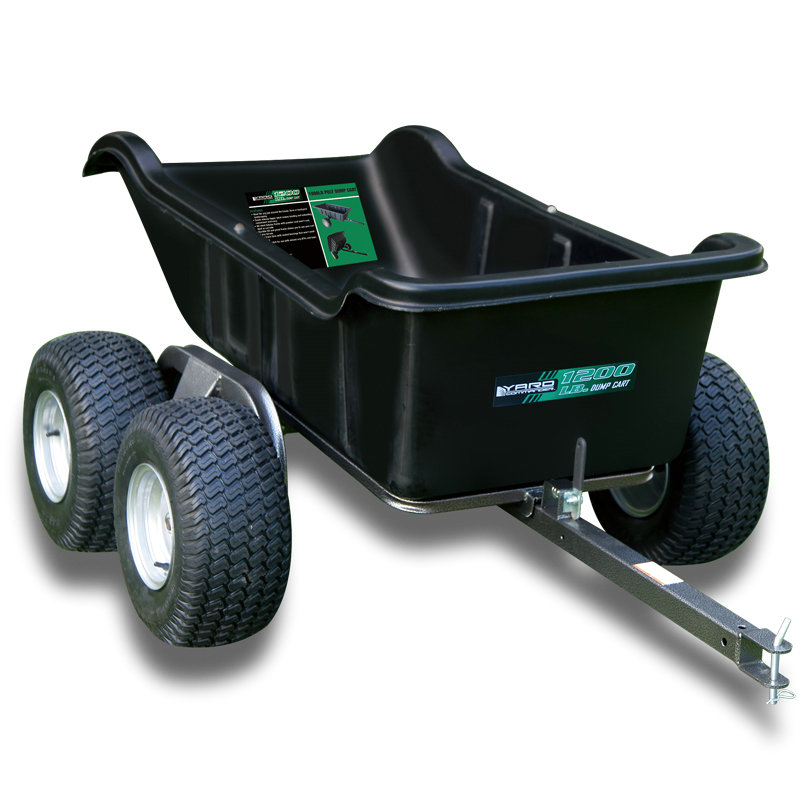 1200 lb Four-Wheel Poly Dump Cart SP 22147Heavy-duty four-wheel poly dump cart with 1200 lb capacity, quick-release latch, 18-inch wide-track tires, and pass-through axle for farm or landscape work.View Product →
Dump Action, Latch and Hitch: Test Them Under Load
A dump cart earns its name at the moment the latch releases. Two designs dominate:
- Pivot or tip beds: the bed rotates on a rear pivot and the load slides out the back. Simple, durable and enough for soil, mulch and compost.
- Full-tilt or high-lift beds: the bed rises before it tips, which helps when emptying into a raised bed. More moving parts, more to maintain.
Whatever the design, the latch is the part that fails. Check that it releases with one hand while the cart is fully loaded, and that the catch is steel rather than plastic. A plastic latch on a 1,000 lb cart is a warranty claim waiting to happen.
Hitch type matters for towing. A pin hitch suits garden tractors and ATVs at walking pace, while a ball coupler stays more secure on uneven ground. Keep tongue weight modest and never pull a loaded hand cart at road speed.
What the Common Load Ratings Actually Mean
Poly dump cart ratings cluster around a few standard figures. Here is what each one realistically covers:
400-500 lb
Light garden work: leaves, clippings and bagged compost. Two wheels, bushings, 10 inch tires.
600-700 lb
The homeowner sweet spot: mulch, topsoil in batches, firewood and garden waste.
1,000 lb
Regular property work: soil, gravel in partial loads, feed and fencing materials.
1,200-1,500 lb
Farm, landscape and rental duty: full loads of stone or wet manure, four wheels, serviceable bearings.
Treat every rating as a ceiling, not a target. The most common purchasing mistake is buying a 1,000 lb cart and filling it with a cubic yard of wet sand, which weighs closer to 2,700 lb. Split the load, or move up to a trailer cart with the running gear to match.
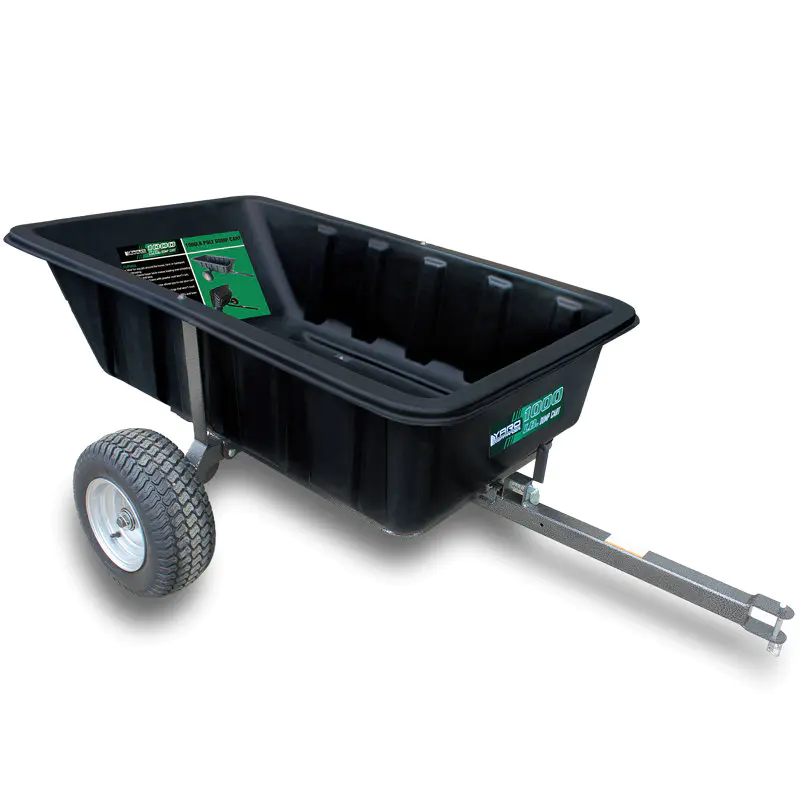 1000 lb Poly Dump Cart SP 22145A 1000 lb poly dump cart for occasional partial loads, with quick-release latch, steel frame, sealed bearings, and 16-inch tires.View Product →
Pre-Purchase Checklist
- Measure the gate, shed door and path width before choosing bed width.
- Confirm the payload rating covers your heaviest load plus 20 percent.
- Check whether the wheels run on bearings or bushings if you will tow weekly.
- Match tires to your ground: pneumatic for rough or soft surfaces, solid for paved paths.
- Test the dump latch and confirm the catch is metal.
- Confirm the hitch type and the stated towing speed limit.
- Ask whether wheels, axles and latches are stocked as spare parts.
- Check UV stabilization or coating if the cart lives outdoors year round.
Frequently Asked Questions
Q1: Is a poly cart strong enough for gravel?
For occasional partial loads, yes. For repeated full loads of gravel or crushed stone, a steel bed with a reinforced axle is the better long-term purchase, because sharp edges abrade plastic and the weight stresses the frame.
Q2: Can I tow a poly dump cart behind an ATV or lawn tractor?
Yes, provided the cart has a pin or ball hitch and the towing machine is rated for the loaded weight. Keep speed low on slopes and turns, and never carry passengers.
Q3: Two wheels or four?
Two wheels tip more easily and cost less. Four wheels are more stable, easier to push when loaded and better on soft ground, but they need more room to turn.
Q4: Do load ratings include the cart's own weight?
No. Payload ratings describe the contents only. A 1,000 lb cart weighing 90 lb puts about 1,090 lb on the tires and axle when fully loaded.
Q5: How do I keep a poly bed from cracking?
Stay inside the rating, spread the load evenly, avoid dropping heavy material into a cold bed, and store the cart out of prolonged direct sun.
A dump cart is a simple machine, and the difference between a good one and a frustrating one sits in four places: the axle, the bearings, the tires and the latch. Get those right and the bed material stops being the deciding factor.
If you are sourcing poly dump carts for a dealership, rental fleet or private-label program, we can walk through payload ratings, axle configurations and hitch options against your market. Start the conversation through our contact page.
PREV:No previous article
NEXT:ATV Disc Buying Guide: Working Width, Weight and Gang Layout Explained
NEXT:ATV Disc Buying Guide: Working Width, Weight and Gang Layout Explained
Interested in cooperation or have questions?
Related products
-
-
◆MODEL NO.: SP22111-4 ◆CAPACITY:400LB/10CU.FT ◆EASY ASSEMBLE DESIGN ◆F...
See Details -
Ideal for any job around the house, farm or backyard landscaping Durab...
See Details -
Ideal for any job around the house, farm or backyard landscaping Durab...
See Details -
Quick release tipper latch makes loading and unloading convenient and ...
See Details -
Quick release tipper latch makes loading and unloading convenient and ...
See Details
