What Are the Two Main Types of Fertilizer Spreaders?
If you want a healthy, evenly nourished lawn, choosing the right tool matters just as much as choosing the right fertilizer. A Lawn Fertilizer Spreader is designed to distribute granular fertilizer, grass seed, or ice-melt material uniformly across your yard — saving time, reducing waste, and preventing the patchy, burned, or under-fed spots that come from uneven hand-spreading.
There are two primary types of fertilizer spreaders used for lawn care: the broadcast (rotary) spreader and the drop spreader. Each works on a different mechanical principle and excels in different scenarios. Understanding how they differ is the first step to selecting the tool that matches your lawn size, layout, and goals.
Type 1: Broadcast (Rotary) Spreader
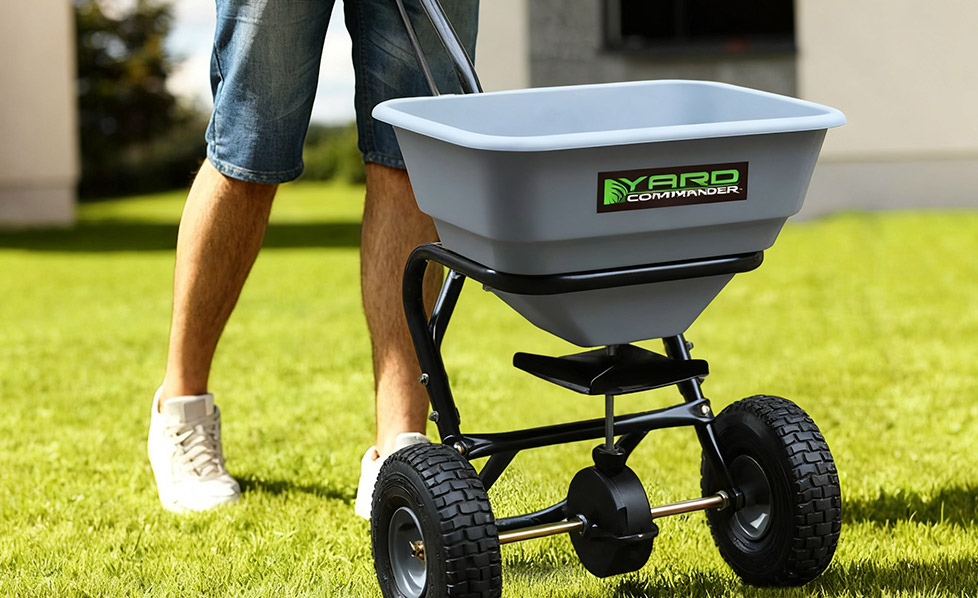
A broadcast spreader — sometimes called a rotary spreader — uses a spinning disc or impeller at the base of its hopper. As you walk and the wheels turn, material flows from the hopper onto the rotating disc, which flings it outward in a wide, fan-shaped pattern. Depending on the model and setting, a single pass can cover a swath of 8 to 12 feet wide, or even more on heavy-duty tow-behind units.
How It Works
The hopper sits above a calibrated opening. A gate controls the flow rate, and most quality broadcast spreaders offer numbered settings so you can match the opening size to the recommended rate on your fertilizer bag. The spinning plate throws material in an arc in front of and to both sides of your path.
Best Use Cases for Broadcast Spreaders
- Large open lawns with few obstacles
- Spreading granular fertilizer, grass seed, or ice melt over wide areas quickly
- Tow-behind use with a lawn tractor or ATV on large properties
- Time-sensitive tasks where speed and coverage efficiency are priorities
Types of Broadcast Spreaders
| Sub-Type |
Hopper Capacity |
Spread Width |
Ideal For |
| Hand-held broadcast |
1–5 lbs |
4–6 ft |
Small yards, spot treatment |
| Walk-behind broadcast |
15–50 lbs |
8–12 ft |
Medium to large home lawns |
| Tow-behind broadcast |
50–130 lbs |
10–20 ft |
Large acreage, tractor use |
Advantages of Broadcast Spreaders
- Speed: Cover large areas in fewer passes — a walk-behind can treat a 10,000 sq ft lawn in roughly 20–25 minutes.
- Efficiency: Fewer overlapping passes needed thanks to wide swath widths.
- Versatility: Works well with fertilizer, seed, sand, salt, and other granular materials.
- Ease of use: Simple to push, and tow-behind models require almost no physical effort.
Limitations of Broadcast Spreaders
- Material can overshoot onto driveways, flower beds, or neighboring areas if not carefully managed near edges.
- Overlapping patterns are harder to judge by eye, which can lead to streaks or double-application strips.
- Wind can carry lighter particles off-target in open areas.
Type 2: Drop Spreader
A drop spreader operates on a different principle entirely. Instead of flinging material outward, it releases granules straight down through a row of holes in the bottom of the hopper. The spread width equals exactly the width of the hopper — typically 18 to 24 inches on most residential models. Material falls only where the spreader passes, creating a clean, controllable band.
How It Works
A rotating agitator bar inside the hopper keeps the material flowing evenly. A sliding gate or series of calibrated holes controls the volume of material released per pass. Because there is no spinning disc involved, the spreader deposits product in a straight, predictable strip matching its physical width.
Best Use Cases for Drop Spreaders
- Small to medium lawns where precise placement is critical
- Areas close to flower beds, walkways, ponds, or hardscaping where overspray must be avoided
- Applying pre-emergent herbicides or weed control products that must not contact garden plants
- Overseeding in specific bare patches without wasting seed on already-covered areas
Advantages of Drop Spreaders
- Precision: Material lands exactly where you walk — no guessing about distribution patterns.
- Edge control: Ideal for treating right up to borders, sidewalks, and garden beds without contamination.
- Even application: Less affected by wind conditions because granules fall vertically.
- Lower product waste: No material is thrown beyond the intended zone.
Limitations of Drop Spreaders
- Slower than broadcast spreaders on large lawns — treating a 10,000 sq ft yard can take twice as long due to the narrow swath.
- Overlapping passes must be precise; even a 1–2 inch gap between passes can result in visible stripes of under-treated grass.
- Not practical for very large properties unless you have significant time to spare.
Broadcast vs. Drop Spreader: Side-by-Side Comparison
| Feature |
Broadcast Spreader |
Drop Spreader |
| Spread width |
8–20 ft |
18–24 inches |
| Application precision |
Moderate |
High |
| Speed on large lawns |
Fast |
Slow |
| Wind sensitivity |
Higher |
Very low |
| Edge control |
Requires care |
Excellent |
| Best lawn size |
Medium to large (5,000+ sq ft) |
Small to medium (under 5,000 sq ft) |
| Tow-behind option |
Yes |
Rarely |
| Ideal near garden beds |
Not recommended |
Yes |
Key Features to Look for in Any Fertilizer Spreader
Regardless of which type you choose, the build quality and design features of your spreader will significantly impact how well it performs and how long it lasts. Here are the most important attributes to evaluate:
Hopper Material and Capacity
Look for UV-resistant, rust-proof poly (polyethylene) hoppers. Steel hoppers can corrode when exposed to fertilizer salts and moisture. For a standard home lawn of around 5,000 to 10,000 sq ft, a hopper capacity of 50 lbs is typically sufficient for a full treatment in one fill.
Calibration and Settings
A well-calibrated spreader will have a clearly numbered rate dial or gate indicator that corresponds with bag instructions. Look for spreaders that include a calibration chart, or whose gate settings are printed directly on the hopper. Inaccurate calibration is the most common reason for over- or under-fertilizing.
Shut-Off Mechanism
A reliable, instant-close shut-off (typically a hand lever that engages the gate) is essential to prevent material from spilling when you stop walking — such as at the end of a row or when turning around. This simple feature dramatically reduces waste and prevents fertilizer burns from stationary dumping.
Frame and Wheel Construction
Powder-coated steel frames resist rust better than bare steel. Pneumatic (air-filled) tires roll more smoothly over uneven terrain than solid plastic wheels, which is especially important on lawns with slopes or bumpy surfaces. Larger-diameter wheels also help maintain consistent walking speed on soft ground.
Edge Guard (Broadcast Models)
Many quality broadcast spreaders now include an edge guard — a deflector plate that blocks half the spread pattern when you're working along driveways, sidewalks, or garden borders. This feature alone can save significant product and prevent damage to non-target areas.
How to Use a Fertilizer Spreader Correctly
Even the best spreader produces poor results if used incorrectly. Follow these steps for clean, even, professional results:
- Read your fertilizer bag: Each product specifies an application rate in pounds per 1,000 sq ft and recommends spreader settings by brand/model. Always start with the manufacturer's recommended setting.
- Calibrate before you begin: If using a new product or a new spreader, do a test run on a tarp or driveway, weigh the output, and adjust the gate until you hit the target rate.
- Apply in a checkerboard pattern for drop spreaders: Make passes in one direction, then apply a second set of passes perpendicular at half the rate. This ensures no strips are missed.
- Maintain a consistent walking speed: Speeding up or slowing down changes the application rate, even when the gate setting is fixed. Aim for a natural, even pace — typically about 3 mph.
- Close the hopper gate at every turn: Always engage the shut-off before stopping or changing direction to avoid over-applying in headland areas.
- Clean the spreader after every use: Fertilizer and salt attract moisture, which causes corrosion. Rinse and dry the hopper, agitator, and frame after each application session.
Choosing the Right Spreader for Your Lawn
Neither spreader type is universally superior. The right choice depends on the specifics of your situation. Use these guidelines as a starting point:
Choose a Broadcast Spreader if:
- Your lawn is larger than 5,000 sq ft and relatively open
- You fertilize frequently and want to minimize time spent on the task
- You own a riding mower or ATV and want a tow-behind option
- You also want to spread ice melt, sand, or grass seed over wide areas
Choose a Drop Spreader if:
- Your lawn is under 5,000 sq ft or has many curves, obstacles, and border areas
- You need to apply pre-emergent herbicide or weed-and-feed products near garden beds
- You are overseeding specific bare patches and want zero seed waste
- You live in a windy area where broadcast spreading causes drift
Consider Owning Both
Many serious lawn enthusiasts keep one of each. A broadcast spreader handles the bulk of routine fertilizer applications on the main lawn area, while a drop spreader is used for edge strips, around garden beds, and for precise overseeding. The combined investment is moderate compared to the improved results you get from using the right tool in every zone of your yard.
Spreader Maintenance Tips for Long Service Life
A well-maintained spreader can last 10 years or more. Neglected units often fail within 2–3 seasons due to corrosion and clogging. Follow these maintenance habits:
- Rinse after every use — especially after spreading fertilizer, which is highly corrosive to metal parts.
- Lubricate moving parts — apply a light machine oil or silicone spray to axle bearings, gate linkages, and agitator shafts at the start of each season.
- Store in a dry location — covered storage or a garage prevents moisture from accelerating corrosion between uses.
- Inspect the hopper gate annually — a worn or warped gate seal can cause uneven flow even when the dial appears correctly set. Replace gate parts if needed.
- Check tire pressure (on pneumatic-tire models) before each use — underinflated tires cause the spreader to roll unevenly, affecting application consistency.
- Clear the hopper opening — if granules cake inside the drop holes or around the agitator, clean with a stiff brush before reloading with fresh material.
Frequently Asked Questions
Q1: What is the main difference between a broadcast and a drop spreader?
A broadcast spreader throws material outward in a wide arc (8–20 ft), while a drop spreader releases material straight down in a narrow band equal to the hopper width (18–24 in). Broadcast is faster; drop is more precise.
Q2: Which type of spreader is better for a small yard?
A drop spreader is generally better for small yards under 5,000 sq ft, especially those with flower beds, pathways, or tight borders where precision matters.
Q3: Can I use a fertilizer spreader for grass seed?
Yes. Both broadcast and drop spreaders work well for grass seed. Use a lower flow-rate setting and check the seed bag for the recommended spreader setting.
Q4: How do I prevent over-applying fertilizer with a spreader?
Always set the gate to the rate printed on your fertilizer bag, walk at a consistent pace, and shut the gate off at every turn or stop. Calibrate with a test run if you are using a new product.
Q5: How often should I clean my spreader?
After every single use. Fertilizer residue is corrosive and can seize moving parts within days if left to sit, especially in humid conditions.
Q6: What hopper capacity do I need for an average home lawn?
For a lawn of 5,000–10,000 sq ft, a 50 lb hopper is usually sufficient to complete the job in one fill at standard application rates of 2–4 lbs per 1,000 sq ft.
Q7: Is a tow-behind spreader worth it?
For lawns larger than half an acre, a tow-behind broadcast spreader saves significant time and effort. It attaches to a lawn tractor or ATV and can cover large areas in a fraction of the time of a walk-behind unit.

 LANGUAGE
 English
 Deutsch
 Español
 Français
 русский